Scholar / Engram: An Academic Operating System for Source-Grounded Learning

Scholar is an academic operating system for source-grounded learning, research, and knowledge production. It is designed as a broader platform for managing the full lifecycle of academic work: organizing sources, reading deeply, synthesizing research, designing learning plans, evaluating epistemic structure, writing academic outputs, studying effectively, mapping knowledge, managing coursework, and translating work into portfolio artifacts.
Engram is the first developed layer inside Scholar. It focuses on close reading, annotation, source-grounded AI support, synthesis, literature-review workflows, and the transformation of reading activity into reusable academic deliverables.
This case study focuses on Engram as the first visible implementation of the Scholar platform vision.
Origin of the Idea
The idea for Scholar emerged from a practical bottleneck in my own academic work. As I read more papers, information architecture and organization became recurring problems. I needed a consistent place to keep sources, notes, annotations, questions, and emerging ideas connected to one another instead of scattered across separate files, apps, and conversations.
Engram came first because close reading was the immediate pain point. I wanted a workspace where papers, highlights, annotations, tags, AI-supported responses, and later synthesis could remain under one umbrella. Keeping those actions together reduced cognitive load because I no longer had to reconstruct the relationship between a source, a note, and the academic task that made the note useful.
That experience shaped the broader Scholar vision. Engram began as a solution to source organization and annotation friction, but it pointed toward a larger academic operating system: a platform where reading, research management, synthesis, writing, learning, planning, and portfolio translation could eventually share context instead of operating as disconnected workflows.
The Platform Vision
Scholar is not meant to be only a research-management tool, a reading app, or an AI writing assistant. It is a platform concept for academic knowledge work. The long-term goal is to support the connected work students and researchers already do across many fragmented tools: managing sources, building context, reading, annotating, synthesizing, writing, studying, planning, and translating academic work into public-facing artifacts.
The platform is organized around the idea that academic work should preserve source context, project context, learning history, and user judgment. AI can help with retrieval, pattern recognition, explanation, classification, drafting, synthesis, and export, but it should operate inside a meaningful academic workflow rather than as a detached chatbot.

Scholar Platform Architecture
Scholar is designed as a modular academic operating system. Its eventual architecture may include:
- Scholar Brain: a cross-platform academic AI assistant that understands projects, sources, annotations, assignments, plans, and learning history.
- Research Control Room: a research operations layer for projects, source corpora, queues, metadata, tags, triage, and workflow states.
- Engram: a source-grounded reading, annotation, synthesis, literature-review, and academic deliverable environment.
- Learning Architect: an adaptive learning-design layer that researches a topic, diagnoses the learning task, builds a structured learning map, and creates an academic action plan.
- Epistemic Audit: a rigor layer for ontology, epistemology, assumptions, claim types, evidence standards, and inference boundaries.
- Writing Studio: a source-grounded academic production layer for outlines, papers, annotated bibliographies, reading summaries, literature reviews, and structured drafts.
- Study and Retrieval Lab: a durable learning layer that turns readings, annotations, and concepts into flashcards, retrieval questions, spaced review, practice quizzes, and exam preparation.
- Concept Graph: a knowledge architecture layer connecting sources, annotations, claims, concepts, theories, questions, and projects.
- Course Workspace: an academic planning layer for classes, assignments, rubrics, deadlines, required readings, study plans, and submission checklists.
- Portfolio Studio: a professional translation layer that turns academic work, research projects, case studies, artifacts, reflections, and AI workflows into public-facing portfolio materials.
The current artifact centers on Engram because it is the most developed part of the system. Engram demonstrates the core design principle that should govern Scholar as a whole: AI should support source-grounded academic work without replacing reading, interpretation, judgment, or accountability.

The Problem
Academic work often happens across disconnected environments. A student may collect sources in one place, read PDFs somewhere else, take notes in another tool, ask AI questions in a separate chat, manage deadlines in a planner, and then reconstruct everything later for a paper, exam, literature review, annotated bibliography, or portfolio artifact.
That fragmentation creates several problems. Sources become separated from notes. Annotations are not always reusable. AI interaction can become detached from the original evidence. Research projects lack clear workflow states. Reading, synthesis, writing, study, and export happen in separate environments.
The result is an academic workflow that depends heavily on memory, manual organization, and repeated reconstruction. The learner may produce useful highlights, summaries, questions, and reflections, but those artifacts are not always connected to the source, the project, or the next academic task.
Engram as the First Developed Layer
Engram brings the user into the source itself. It is the close-reading and annotation environment inside Scholar. The reading interface is designed to combine source management, PDF reading, highlighting, annotation capture, contextual note review, AI-supported synthesis, and exportable academic outputs.
This layer is built around a specific principle: AI support should respond to source-grounded learner activity. The learner reads, selects, marks, annotates, tags, and interprets. AI can then support those actions by explaining difficult passages, generating summaries, suggesting questions, connecting concepts, or helping transform annotations into learning objects.
The ethical boundary is built into the workflow. The source remains visible. The annotation is tied to the learner’s action. AI is positioned as support for interpretation and synthesis, not as a replacement for reading.

Learning Workflow
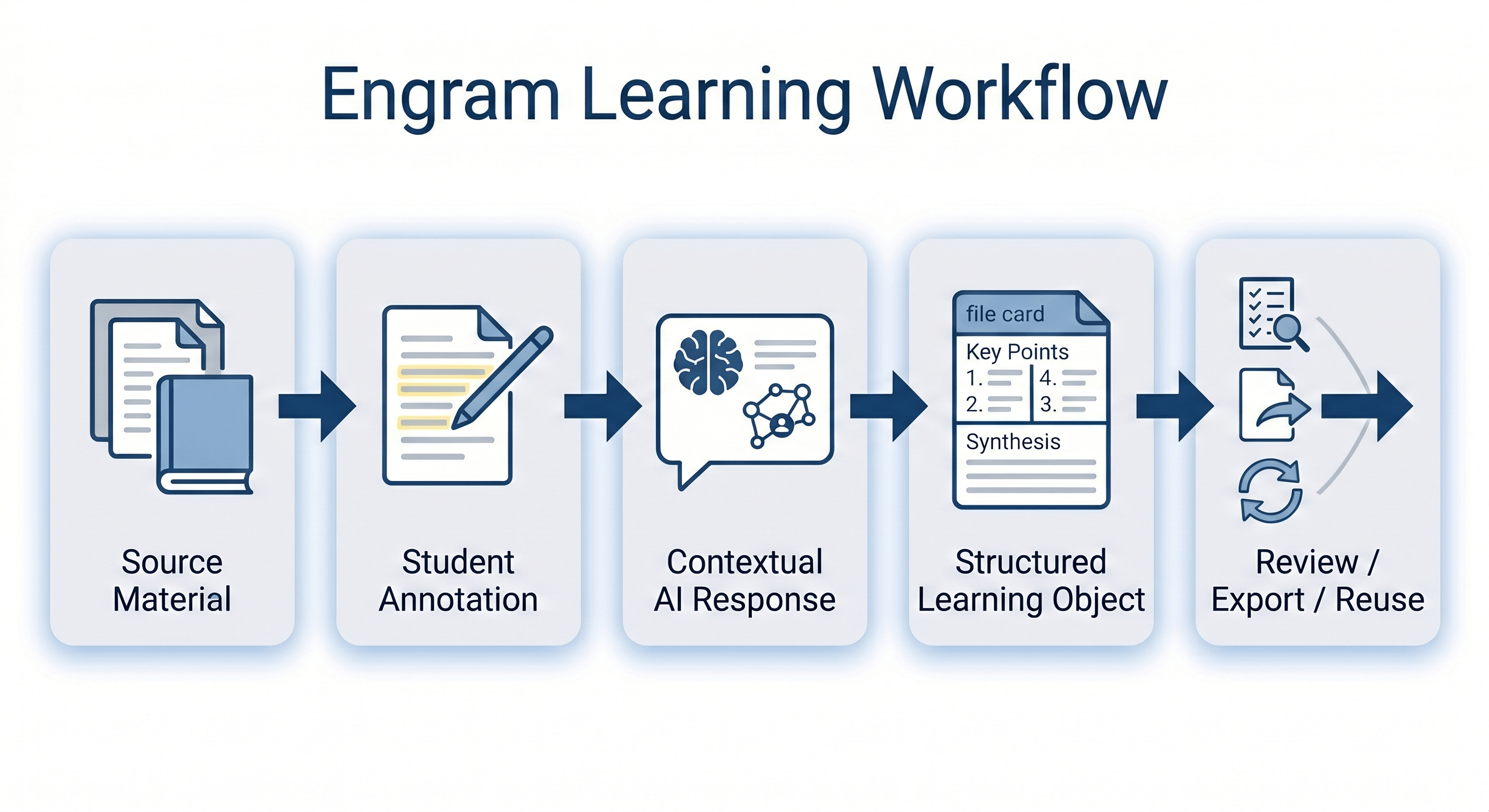
Engram’s workflow begins with the source, not the model.
This sequence matters because it keeps interpretation anchored in evidence and keeps the learner responsible for evaluation. AI support enters after the learner has acted on the material. The output can become a concept card, paraphrase, evidence note, comparison node, study question, reading summary, annotated bibliography item, or notebook export.
AI-Supported Synthesis and Deliverable Creation
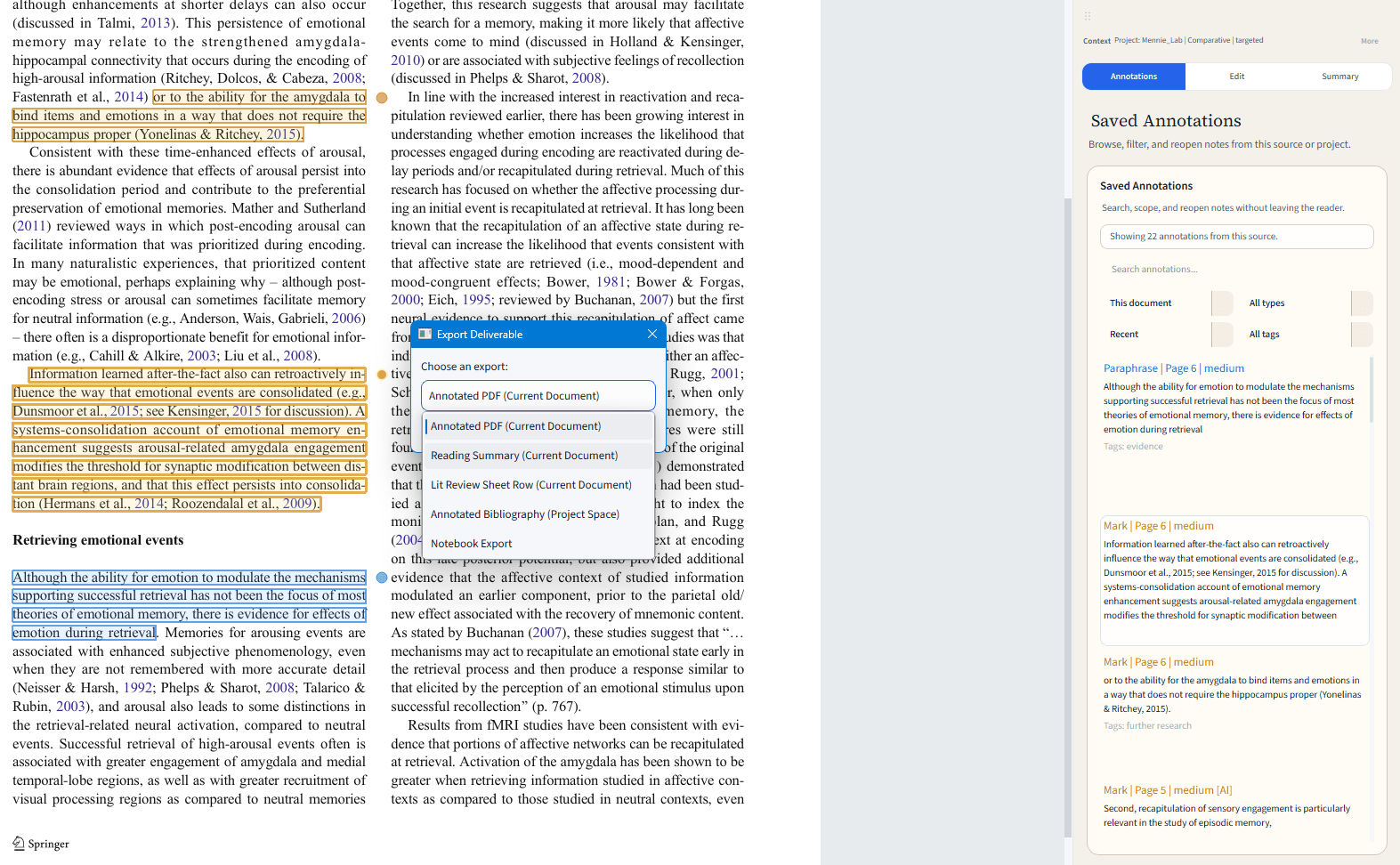
Engram also includes an AI-supported synthesis layer. This layer helps transform source-grounded reading into structured academic outputs such as reading summaries, annotated bibliography material, notebook exports, review questions, study objects, and section-level summaries.
The important design choice is that AI is not detached from the reading workflow. It operates against source material, document structure, annotations, tags, and project context. The user initiates generation, evaluates the result, saves useful outputs, and decides what becomes part of their academic work.
This makes AI part of a structured learning system rather than a general answer engine.
Responsible AI Design
Scholar / Engram uses AI as a bounded support layer. AI may assist interpretation, organization, retrieval, classification, drafting, synthesis, and formatting, but it does not replace reading, judgment, or accountability.
Human Judgment
- Selects sources
- Chooses what to annotate
- Evaluates claims
- Accepts, rejects, or revises output
- Determines what becomes part of the knowledge structure
AI Support
- Suggests metadata
- Explains difficult passages
- Generates summaries
- Supports classification
- Formats exportable deliverables
The boundary is simple: AI may help organize and transform academic work, but the learner remains responsible for reading, interpretation, evidence evaluation, and final judgment.

What This Demonstrates
Scholar / Engram demonstrates AI use at the workflow level. It is not simply a tool for generating text. It is an attempt to design AI into an academic reading, research, and learning environment where source management, annotation, synthesis, writing, study, and export can become connected parts of one system.
The project demonstrates product architecture, information architecture, source-grounded AI use, academic workflow design, learning science reasoning, responsible AI boundary-setting, interface design, and the transformation of reading into reusable learning artifacts.
The broader claim is that AI becomes more useful, and more ethical, when it is attached to a meaningful workflow. In Scholar / Engram, AI is not the center of the system. The source, the learner, the annotation, the project, and the academic task remain central.
This case study was drafted and structured using ChatGPT with WPWriter integration, demonstrating iterative AI-assisted content development and refinement.